
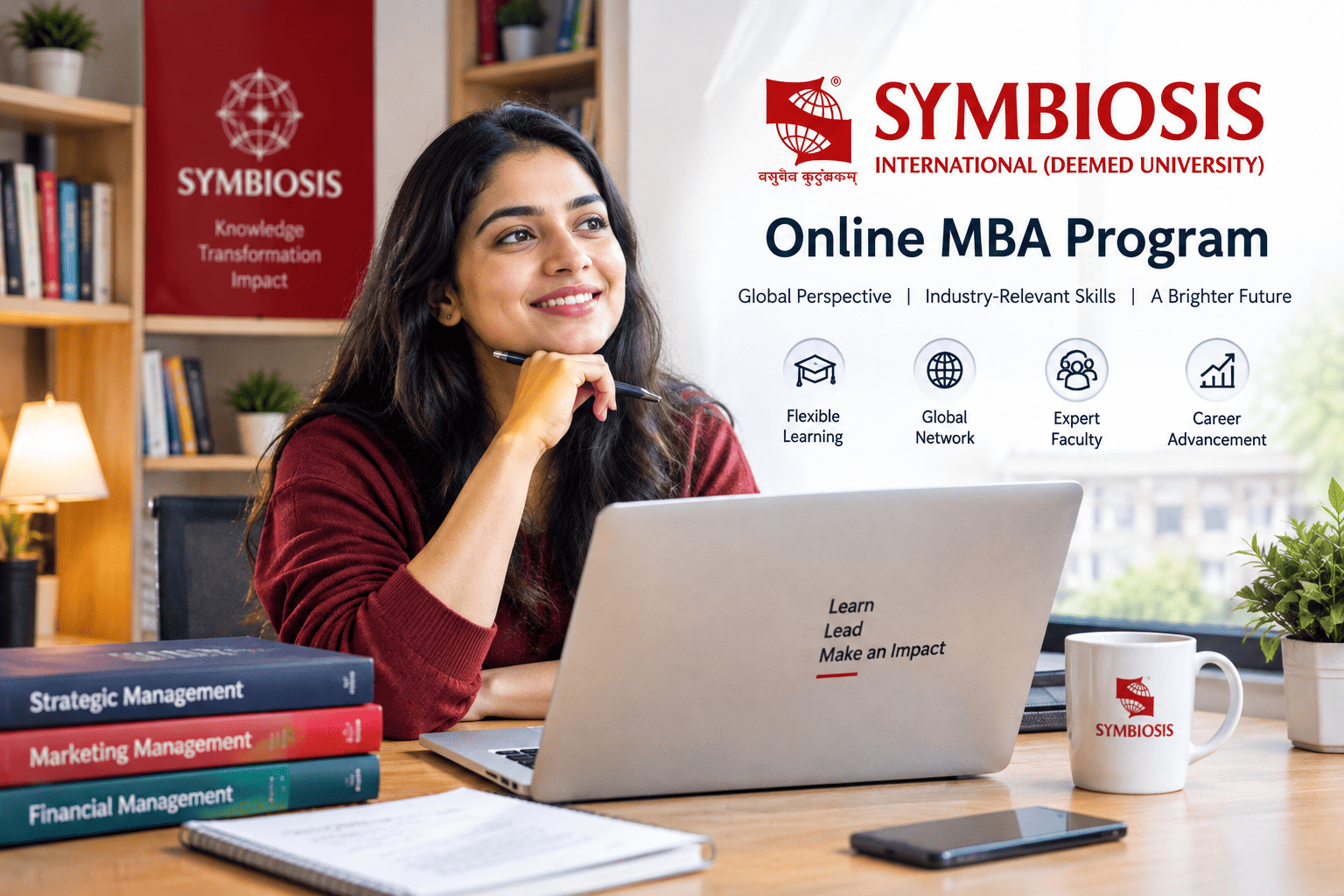
If you are a working professional eyeing a credible management degree without pressing pause on your career, the Symbiosis Online MBA sits right at the intersection of brand value, flexibility, and academic rigour. Offered by the Symbiosis School for Online and Digital Learning (SSODL), a constituent of Symbiosis International (Deemed University), this programme has quietly become one of the most searched online MBA options in India.
But is it worth the premium? And more importantly, is it built for you?
This guide breaks down everything that matters: fees, specialisations, curriculum, approvals, admission timelines, placement reality, and what actual students say. No fluff, no recycled brochure language. Just the details you need to make a confident decision.
What Is the Symbiosis Online MBA?
The Symbiosis Online MBA is a two-year, four-semester online management degree delivered entirely through SSODL’s digital learning platform. It carries the weight of Symbiosis International (Deemed University), an institution with a 51-year legacy, a NAAC A++ grade, UGC Category-I status, and AICTE approval.
In NIRF 2025, the parent university was ranked 24th among universities in India, and its management discipline sat at rank 11.
Why does this matter? Because the online education market is crowded with programmes that look identical on paper. The differentiator is not just the curriculum, it is the credibility of the degree-granting body. A UGC-entitled online MBA from a Category-I university carries immediate acceptance in corporate HR screening, government job applications, and higher education pathways.
For professionals who cannot afford a career break, this programme offers a recognised stamp without the opportunity cost of a full-time campus MBA.
This programme is not for everyone, though.
It is recommended for working professionals with at least two years of experience who want to move into mid-senior roles, switch functions, or formalise their management skills. It also suits entrepreneurs, self-employed professionals, and defence or public-sector employees who need a flexible, credible qualification.
Fresh graduates can apply, but they should be realistic about the fact that online MBAs offer career assistance, not guaranteed campus placements.
Approvals and Recognition:
Before you commit ₹3 lakh or more, verify the stamp. Here is what SSODL publicly confirms:
| Approval or Recognition | Status |
|---|---|
| UGC Entitlement | Yes, Category-I university |
| AICTE Approval | Yes |
| NAAC Accreditation | A++ |
| NIRF 2025 University Rank | 24 |
| NIRF 2025 Management Rank | 11 |
| Degree Type | Master of Business Administration (Online) |
| WES Recognition | Recognised (useful for international pathways) |
Source: SSODL official disclosures and public accreditation records.
The UGC-DEB framework governs online degrees in India, and a degree from a UGC-entitled institution is treated as equivalent to a regular MBA for most employment and higher-education purposes. The AICTE stamp adds another layer of validity for management programmes. If a programme cannot show these approvals clearly, walk away. Symbiosis does.
Symbiosis Online MBA Fees 2026:
The standard total programme fee is ₹3,70,000 for Indian students. However, SSODL offers a ₹55,000 fee concession to applicants with at least two years of work experience, which brings the net payable fee down to ₹3,15,000 for the entire two-year programme.
A separate one-time payment concession of ₹50,000 has also been reported, reducing the net fee to approximately ₹2,65,000 in some fee structures. Always confirm the live fee slab on the official portal at the time of application, because concessions are conditional and can change by intake.
| Fee Component | Standard (No Concession) | With Work-Experience Concession |
|---|---|---|
| Application Fee | ₹1,000 | ₹1,000 |
| Registration Fee | ₹10,000 | ₹10,000 |
| Semester 1 | ₹92,500 | ₹80,000 |
| Semester 2 | ₹92,500 | ₹80,000 |
| Semester 3 | ₹87,500 | ₹72,500 |
| Semester 4 | ₹87,500 | ₹72,500 |
| Total Programme Fee | ₹3,70,000 | ₹3,15,000 |
Fee data compiled from SSODL-linked official breakdowns.
Payment flexibility: Semester-wise payments are allowed. EMI options are available through partner fintech platforms. There is no separate hostel fee for this programme because it is a 100% online degree. Hostel facilities at Symbiosis campuses are reserved for full-time, on-campus students and are not bundled with the online MBA.
If you are relocating for another reason, Symbiosis’s residential campuses at Lavale and Hinjewadi offer hostel rooms ranging from semi-furnished to fully serviced, but those are separate from this online programme.
Specialisations:
SSODL offers 9 to 11 specialisation tracks under the online MBA, depending on the intake cycle.
The officially listed specialisations include Marketing, Human Resource Management, Finance, Operations, Business Analytics, Logistics and Supply Chain Management, Agri Operations Management, International Business, and Hospital and Health Care Management. FinTech and ESG and Sustainability have also appeared in recent admission cycles, reflecting market demand.
| Specialisation | Best For | Core Focus Areas |
|---|---|---|
| Marketing | Brand, growth, and sales professionals | Consumer behaviour, digital marketing, brand management, integrated communication |
| Finance | Analysts, bankers, and finance aspirants | Corporate valuation, mergers and acquisitions, derivative markets, portfolio management |
| Human Resource Management | HR generalists and people-operations professionals | Talent management, labour law, HR analytics, learning and development |
| Business Analytics | Data-driven managers and consultants | Spreadsheet modelling, visual analytics, HR analytics, financial analytics |
| Operations | Manufacturing and service-operations professionals | Project management, operations research, process optimisation |
| Logistics and Supply Chain | Supply-chain and e-commerce professionals | Warehouse management, lean six sigma, sustainable supply chain |
| International Business | Export-import and global-role aspirants | Trade finance, FOREX management, international marketing, global HR |
| Hospital and Health Care Management | Healthcare administrators and clinicians | Hospital planning, clinical services management, healthcare IT, accreditation |
| Agri Operations Management | Agribusiness and rural-value-chain professionals | Agri supply chains, operations, and rural market strategy |
Specialisation list based on SSODL programme disclosures.
Here is the strategic point: choose a specialisation that extends the story your resume already tells. A marketing professional moving into a brand-leadership role should pick Marketing, not Business Analytics, unless the goal is a deliberate pivot. The online MBA is a career amplifier, not a reset button.
Semester-by-Semester Snapshot
The curriculum is built around 100 credits across four semesters, blending core management foundations with specialisation electives and applied projects. The first two semesters are largely common across tracks, covering the language of business. The final two semesters go deep into your chosen domain.
Semester 1 (Core Foundations): Business Statistics, Marketing Management, Financial Accounting, Operations Management, Legal Aspects of Business, Human Resource Management, Research Methodology, Microeconomics, Technology in Business, and an Enterprise Risk Management module.
Semester 2 (Core + Emerging Tools): Organisational Behaviour, Operations Research, Financial Management, Project Management, Business Communication, Consumer Behaviour, Digital Marketing, Design Thinking, Innovation Management, R Programming, and Generative AI and Use Cases.
The inclusion of generative AI and R programming is a deliberate signal: the programme is updating its toolkit for the current business environment, not recycling a 2015 syllabus.
Semester 3 (Specialisation + Strategic Core): Corporate Governance and Ethics, Strategic Management, Crisis Management, AI and ML for Business Management, Health and Wellness, and the first specialisation project. For Finance, for example, this semester covers derivative markets, mergers and acquisitions, corporate valuation, and security analysis.
Semester 4 (Specialisation Capstone): Advanced electives in your track and Project II, a structured research or applied business project. This is where you produce a tangible artefact, a valuation report, a supply-chain redesign, an HR analytics dashboard, or a go-to-market plan, that you can discuss in a job interview.
What you will not get: the daily, in-person peer intensity of a full-time residential MBA. The learning is real, but the network effect is different. Live sessions, recorded lectures, discussion forums, and peer doubt-solving channels exist, but you have to show up and engage deliberately.
Admission Dates and Process for 2026
SSODL runs two admission cycles per year: January and July. For the January 2026 session, applications were open with a reported last date of 30 March 2026. For the July 2026 session, the application window opened around 15 April 2026, with a last date of 10 May 2026 reported by some admission trackers, and later extensions to 30 August or 31 August 2026 reported for certain specialisations and cycles.
A separate July 2026 batch deadline of October 15–30, 2026 has also been listed in some admission summaries.
The practical takeaway: deadlines in online admissions are often extended, but seat capacity is finite. Reported intake capacity ranges from 10,000 to 13,000 seats across specialisations, and popular tracks like Business Analytics and Finance can fill earlier. Apply at least four to six weeks before your preferred deadline.
Eligibility is straightforward: a bachelor’s degree from a recognised university with minimum 50% marks (45% for SC/ST candidates). No CAT, MAT, XAT, or SNAP score is required. Work experience is not mandatory for admission, but it is required to unlock the ₹55,000 fee concession.
Application steps: create a DEB ID (mandatory for online degrees in India), register on the SSODL portal, upload Class 10, 12, and graduation documents, pay the ₹1,000 application fee, and complete the programme-fee payment or first instalment.
Why Choose the Symbiosis Online MBA Programme?
Because brand credibility compounds. In a market where every second online provider claims “UGC approved,” Symbiosis backs it with Category-I UGC status, NAAC A++, AICTE approval, and a top-25 NIRF university rank. That combination is not common.
The degree carries weight in corporate HR filters, in public-sector promotions, and in higher-education applications, including international pathways where WES recognition matters. The 51-year institutional legacy, 80,000+ active online learners, and a 12-lakh-strong alumni network create a brand halo that a standalone edtech platform cannot replicate.
If you are spending ₹3 lakh on a qualification, the name on the certificate is a career asset, not a line item.
Placement Reality:
Let us separate marketing from mechanics. No UGC-recognised online MBA guarantees a job. UGC regulations prohibit placement guarantees, and SSODL does not run the same campus recruitment drives as its full-time residential MBA programmes.
What it does offer is placement assistance: resume building, interview preparation sessions, career counselling, industry webinars, and access to virtual placement drives with recruiter networks.
Reported outcomes give a directional picture, not a promise:
| Outcome Metric | Reported Data |
|---|---|
| Average package (online MBA alumni) | ₹6 LPA to ₹10 LPA |
| Highest reported package | ₹14 LPA to ₹18 LPA |
| Placement percentage (reported) | 85% to 88% |
| Common roles | Marketing Manager (₹6–12 LPA), Financial Analyst (₹5–10 LPA), HR Manager (₹6–10 LPA), Operations Manager (₹7–14 LPA), Business Consultant (₹8–15 LPA) |
Data drawn from multiple independent placement trackers and salary aggregation reports.
The ₹6–10 LPA average is heavily influenced by prior work experience. A professional entering with five years of experience and a clear specialisation will almost always out-earn a fresh graduate using the same degree. The ₹1 lakh higher floor compared to some competitors is real, but the ceiling depends on your interview performance, domain skills, and the projects you build during the programme.
Student Reviews:
Feedback across public forums, review platforms, and community discussions is genuinely mixed, and that is useful information. The most consistent positives centre on flexibility and academic structure: weekend live sessions, on-demand recordings, a well-organised learning management system, and a curriculum that is practical enough to apply at work the following Monday.
Working professionals repeatedly mention that the programme respects their time and does not force them to choose between a paycheck and a classroom.
The most consistent criticisms are equally clear. Some learners report uneven responsiveness from support teams, particularly around LMS access and administrative queries, with a few describing delays that undermined their early experience. Peer interaction is frequently described as limited, especially when compared to a full-time MBA; if you thrive on daily campus energy and spontaneous networking, this format will feel thin.
Placement support draws scepticism from some quarters, not because it is absent, but because expectations are often mismatched. Students who expect a campus-placement-style outcome are disappointed; students who use the career services as an add-on to their own job search report better results.
The balanced verdict: the degree is credible, the flexibility is real, and the brand is a genuine asset, but the experience is what you make of it. The programme rewards self-driven learners and punishes passive consumers.
Conclusion:
Enrol if: you are a working professional with two or more years of experience, you need a UGC-entitled MBA from a Category-I university, you want a specialisation that maps to a promotion or a deliberate career pivot, and you are prepared to drive your own networking and job-search outcomes.
Pause if: you are a fresh graduate expecting campus-style placements, you need daily in-person peer learning, or you are looking for the cheapest possible online MBA. This is a premium-priced programme, and the premium buys brand credibility and academic structure, not a guaranteed job.
Frequently Asked Questions
Find answers to common questions about Symbiosis Online MBA fees, eligibility, admission, specialisations, placements and learning facilities.
1. Is the Symbiosis Online MBA UGC-approved and valid for government jobs?
Yes. SSODL operates under Symbiosis International (Deemed University), which holds UGC Category-I status, NAAC A++ accreditation, and AICTE approval. A UGC-entitled online MBA is treated as equivalent to a regular MBA for most government employment and higher-education purposes.
2. What is the actual fee, and are there concessions?
The standard total fee is ₹3,70,000. Applicants with at least two years of work experience are eligible for a ₹55,000 concession, reducing the net fee to ₹3,15,000. A one-time payment concession of ₹50,000 has also been reported in some fee structures, bringing the net payable down further. Always confirm the live fee slab on the official portal.
3. Is there an entrance exam like CAT or SNAP?
No. Admission is based on graduation marks and document verification. There is no CAT, MAT, XAT, or SNAP requirement. The minimum eligibility is 50% in graduation (45% for SC/ST).
4. How many specialisations are available?
SSODL offers 9 to 11 specialisations, including Marketing, Finance, HR, Operations, Business Analytics, Logistics and Supply Chain, International Business, Agri Operations, and Hospital and Health Care Management. FinTech and ESG and Sustainability have appeared in recent cycles.
5. Does the programme provide hostel facilities?
No. The online MBA is a 100% online programme and does not include hostel accommodation. Symbiosis campus hostels are reserved for full-time, on-campus students and are a separate facility.
6. What are the admission deadlines for 2026?
SSODL runs January and July intake cycles. Reported deadlines include 30 March 2026 for the January session, and 10 May, 30 August, or 31 August 2026 for the July session, depending on the specialisation and extension notifications. Seats are limited, so early application is advised.
7. Does the programme guarantee placement?
No. UGC regulations prohibit placement guarantees for online programmes. SSODL offers placement assistance, including resume support, interview preparation, career counselling, and virtual recruiter drives. Reported average packages range from ₹6 LPA to ₹10 LPA, with outcomes heavily dependent on prior experience and individual effort.
8. Can fresh graduates apply, and is the degree worth it for them?
Fresh graduates can apply if they meet the 50% graduation mark requirement. However, the programme’s ROI is strongest for professionals with work experience. Fresh graduates should treat it as a credential-building step while actively pursuing internships and entry-level roles, not as a substitute for campus placement.
Choose the programme for the brand, the flexibility, and the specialisation depth. Do not choose it for a guaranteed job. That clarity, more than any brochure claim, is what will make the degree work for you.