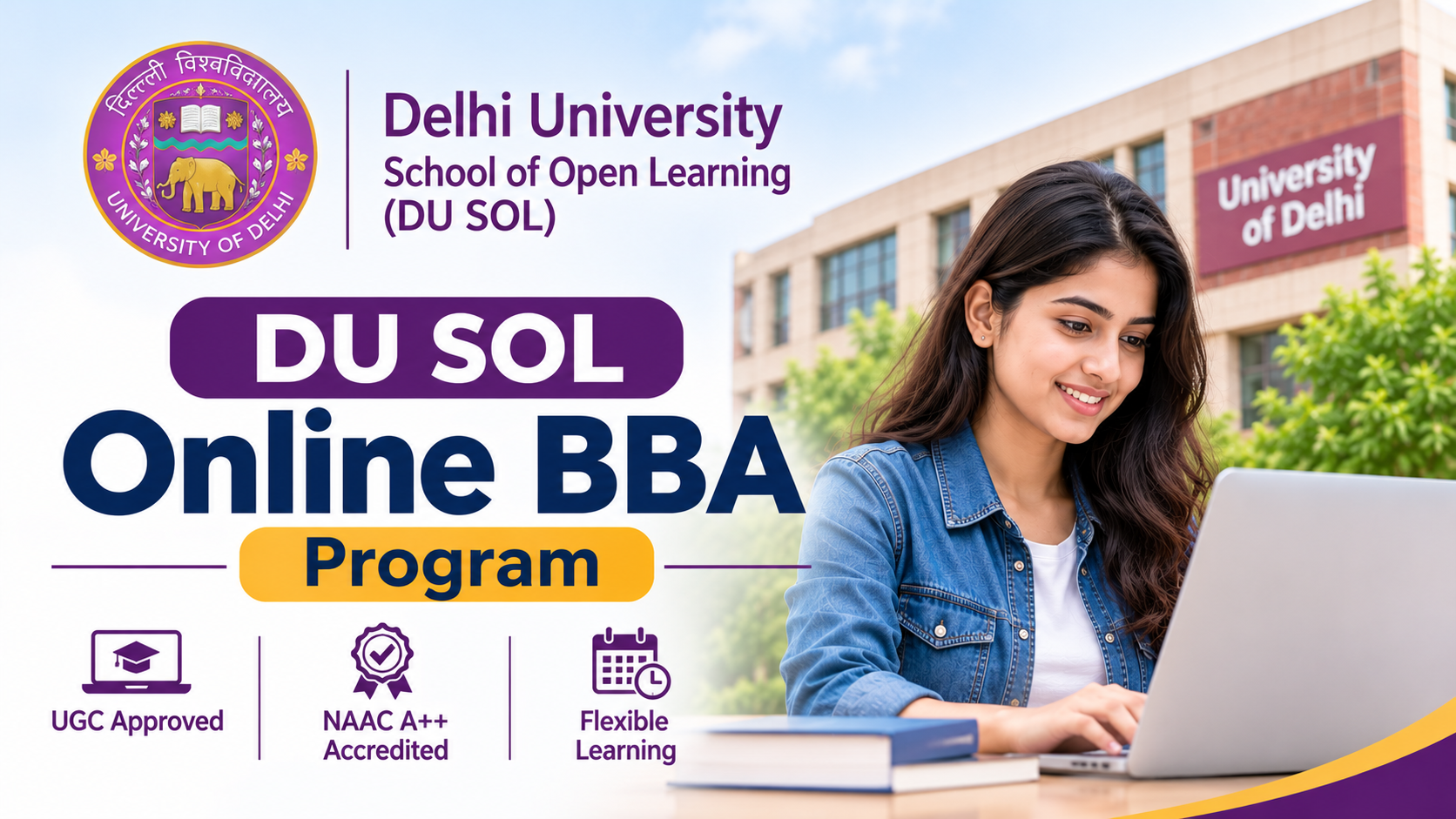
In the current educational era, for many people, including working individuals who wish to get an authentic business degree without having to give up their job or move to Delhi, the DU SOL Online BBA program has been a genuine prospect. The program merges the reputation of the University of Delhi with the benefits of e-learning. However, is it really for you?
Let us discuss some facts related to the program in depth: Fees, eligibility, course, facilities, placements, and student opinions.
What Is the DU SOL Online BBA and Its Important
The School of Open Learning (SOL) at the University of Delhi has been educating learners for over six decades. Its Online BBA is a three-year undergraduate management programme delivered entirely through digital platforms.
You get a University of Delhi degree, structured coursework in marketing, finance, human resources, and entrepreneurship, and the freedom to study from anywhere.
This programme matters because it removes the biggest barriers to a business education: cost, location, and time. A regular BBA from a decent private college can cost upwards of ₹1.5 lakh to ₹5 lakh per year, and that is before living expenses. The DU SOL Online BBA sits in a different bracket altogether, and it is approved by the UGC-Distance Education Bureau (UGC-DEB). That approval is not a formality.
It means the degree is treated as valid for government jobs, higher education, and private-sector employment.
Who Should Enroll in the DU SOL Online BBA?
This programme is not for everyone, and I tell prospective students that upfront. It is a strong fit for:
- Working professionals who need a bachelor’s degree to move into a managerial role but cannot attend daily classes.
- Fresh Class 12 graduates who want a DU degree at a fraction of the cost of a regular college and are self-disciplined enough to study online.
- Career switchers from non-commerce backgrounds who want a structured introduction to business management.
- Aspiring entrepreneurs who want to understand finance, operations, and marketing without pausing their ventures.
- Students in smaller towns who do not have access to a well-ranked business school locally.
If you need daily campus life, sports teams, and in-person networking, this is not the programme for you. If you need a recognised degree, a flexible schedule, and a clear path to an MBA or a job, keep reading.
DU SOL Online BBA Admission 2026: Dates, Eligibility, and Process
The admission cycle for the 2026-27 academic session is already active. According to the official DU SOL online portal, the last date to apply for most undergraduate programmes is July 31, 2026. Some admission trackers show an extended window, but I always advise students to treat the official July date as the real deadline.
Do not wait for an extension that may not apply to your programme.
| Admission Parameter | Details |
|---|---|
| Programme Duration | 3 years (minimum), 6 years (maximum) |
| Mode | Online / Distance Learning |
| Eligibility | Passed 10+2 or equivalent from a recognised board |
| Entrance Exam | No entrance exam; merit-based admission |
| Medium | English and Hindi |
| Approval | UGC-DEB approved; degree awarded by University of Delhi |
| Application Mode | Online through the DU SOL admission portal |
The eligibility for the Online BBA is straightforward: a Class 12 pass from a recognised board. Unlike the BBA (Financial Investment Analysis) track, which often demands specific subject combinations and higher aggregate marks, the Online BBA page states a simple 10+2 pass criterion.
That said, if you are applying for a specialised BBA (FIA) programme, check the subject requirements separately because Mathematics is often mandatory there.
The application process is fully online. You register on the DU SOL admission portal, fill in your personal and academic details, upload your photograph, signature, Class 10 and 12 mark sheets, pay the fee, and download the confirmation. The entire process can be completed in under an hour if your documents are ready.
Approvals
This is a question I get every single day, and the answer is unambiguous. The DU SOL Online BBA is awarded by the University of Delhi and is approved by the UGC-DEB. The University of Delhi holds a NAAC A+ accreditation, and DU SOL itself is recognised by the Distance Education Bureau.
This is not a private “online university” degree. It carries the Delhi University name, and that matters when you apply for a government exam, an MBA, or a corporate job.
Why Choose the DU SOL Online BBA?
The honest reason to choose this programme is the combination of brand, flexibility, and cost. You are getting a University of Delhi degree, one of the most recognised academic brands in India, without paying private college fees or sacrificing your current income.
The programme is designed for self-paced learning, so you can complete coursework around a job or family responsibility, and the UGC-DEB approval ensures the degree is accepted for higher studies and competitive exams.
If your priority is a credible business degree with minimal disruption to your life, this is a very rational choice.
DU SOL Online BBA Fees 2026
Here is where many online articles mislead students. They quote the BBA (FIA) distance programme fee of around ₹63,360 and present it as the Online BBA fee. Those are two different programmes.
The official DU SOL online portal lists the Online BBA fee range as ₹1,75,120 to ₹2,50,000 for the full programme, depending on the specialisation you choose.
| Fee Component | Amount |
|---|---|
| Total Programme Fee (Online BBA) | ₹1,75,120 – ₹2,50,000 |
| Specialisations Available | Data Analytics, Travel and Tourism Management |
| BBA (FIA) Distance Programme Fee (for reference) | ₹63,360 total; ₹21,120 first year |
The fee range reflects the specialisation selected. Data Analytics and Travel and Tourism Management may carry different price points. Always confirm the exact fee for your chosen specialisation on the official portal before paying.
The BBA (FIA) programme, which is a separate distance offering, costs significantly less, but it is not the same as the Online BBA with specialisations.
What You Learn in the DU SOL Online BBA
The curriculum is built around the core functions of a business. It is not a random collection of electives. The programme structure moves from foundations to strategy.
| Year | Core Subjects |
|---|---|
| Year I | Principles of Management, Business Economics, Financial Accounting, Business Mathematics, Business Communication, Environmental Studies |
| Year II | Marketing Management, Human Resource Management, Organisational Behaviour, Business Statistics, Financial Management, Business Law |
| Year III | Strategic Management, Entrepreneurship Development, Operations Management, Business Ethics, E-Commerce, Final Year Project |
By the end of the programme, you should be able to read financial statements, design a marketing plan, understand employment law, and build a basic business strategy. The final-year project is particularly useful because it forces you to apply what you have learned to a real business problem.
Facilities and Benefits
Online learning does not mean you are left alone with a PDF. DU SOL provides a learning management system (LMS) where you can access recorded lectures, digital study materials, assignments, and assessments. You also get access to the student dashboard for exam schedules, results, and e-resources.
The university has four regional centres in Delhi (North, South, East, and West) for administrative support.
Key facilities include:
- LMS access with recorded lectures and case studies.
- Digital library and e-resources through the student dashboard.
- Flexible examination windows and online internal assessments.
- Fee concessions for SC/ST/OBC, PwBD, and BPL students.
- Option to pursue two programmes simultaneously under UGC guidelines.
What you will not get is a bustling campus, daily peer interaction, or a dedicated placement cell that works exclusively for online BBA students. That is the trade-off, and it is better to know it now than to discover it later.
Placement and Career Opportunities
Placement data for online and distance programmes is always murkier than for full-time campus programmes, and I will not pretend otherwise. DU SOL does not run a separate campus placement drive for online learners in the way a regular college does.
However, the University of Delhi does have a central placement cell, and some recruiters do consider SOL students.
Based on student reports and aggregated data, the placement picture looks like this:
| Placement Metric | Indicative Figure |
|---|---|
| Average Package | ₹3–9 LPA |
| Median Package | ₹5 LPA |
| Highest Package (reported) | ₹30 LPA (experienced candidates) |
| Common Recruiters | Axis Bank, ICICI Bank, Genpact, HDB Financial Services, Dabur |
The wide range reflects the fact that online BBA graduates enter the job market with different levels of prior experience. A fresh graduate may start at ₹3–4 LPA, while someone with existing work experience can negotiate significantly higher.
Graduates typically move into roles such as Business Manager, Marketing Executive, Human Resource Officer, Financial Analyst, and Operations Coordinator. The degree is also a valid stepping stone to an MBA.
Student Reviews:
Student feedback on DU SOL is mixed, and that is the most honest way to put it. Across public review platforms, the programme holds ratings in the range of 3.7 to 3.8 out of 5 from verified students. The consistent praise is for flexibility and affordability. Learners appreciate that they can study at their own pace, access materials online, and earn a DU degree without attending daily classes.
Faculty support is often described as approachable, and the syllabus is considered relevant.
The criticism is equally consistent. Students frequently mention communication gaps, delayed study materials, and a lack of proper campus life. Some learners feel treated as “outsiders” compared to regular DU students. Portal glitches during exam periods and delays in result declarations are recurring complaints.
At last we can say that, the students should go in with realistic expectations. This is a degree for self-driven learners. If you need hand-holding, look elsewhere.
Frequently Asked Questions (FAQs)
1. Is the DU SOL Online BBA degree valid for government jobs?
Yes. It is UGC-DEB approved and awarded by the University of Delhi, making it valid for government exams and higher studies, subject to the eligibility requirements of the respective examination or institution.
2. What is the eligibility for DU SOL Online BBA?
Candidates must have passed Class 12 (10+2) or an equivalent examination from a recognised board. There is no entrance exam.
3. What is the last date to apply for 2026?
The official DU SOL portal states July 31, 2026, as the last date to apply for most UG programmes. This date has passed. Check the official admission portal for the latest application schedule and any revised deadlines.
4. How much does the DU SOL Online BBA cost?
The stated official fee range is ₹1,75,120 to ₹2,50,000 for the full programme, depending on specialisation. This is separate from the lower-priced BBA (FIA) distance programme.
5. Is there an entrance exam?
No. Admission is merit-based on Class 12 marks. There is no separate entrance examination for the programme.
6. Can I pursue a job while studying?
Yes. The programme is designed for self-paced learning, and the maximum duration of 6 years gives students additional flexibility to balance their studies with employment.
7. Does DU SOL provide placement assistance for Online BBA students?
There is no dedicated campus placement drive for online learners. You can access DU’s central placement resources, but you must be proactive in finding and applying for suitable opportunities.
8. What specialisations are available in the Online BBA?
Data Analytics and Travel and Tourism Management are listed on the official portal.
9. Is the degree accepted for an MBA?
Yes. A UGC-DEB-approved bachelor’s degree is accepted for MBA admissions, subject to the eligibility criteria and admission requirements of the specific university.
10. What is the maximum duration to complete the programme?
The maximum duration is six years, while the minimum duration is three years.